Logo Musée du Patrimoine

All French heritage classified by regions, departments and cities

Castles and Military Heritage Religious heritage Industrial heritage Heritage of cities Archaeological heritage Museums Attractions and tourist attractions The most beautiful villages The most beautiful monuments in France

Gallo-Roman vestiges in Lot-et-Garonne

Retrouvez les 4 Gallo-Roman vestiges in Lot-et-Garonne recensés par Musée du Patrimoine de France.
Nous proposons également plusieurs hébergements dans le Lot-et-Garonne
Département

4 gallo-Roman vestige dans le Lot-et-Garonne

Gallo-Roman villa vestiges of the Lower Empire

47170 Mézin

The remains of the Gallo-Roman villa of the Lower Empire in Mézin, New Aquitaine, date from late antiquity. This archaeological site bears witness to the Roman occupation in the region.
Gallo-Roman amphitheatre

47000 Agen

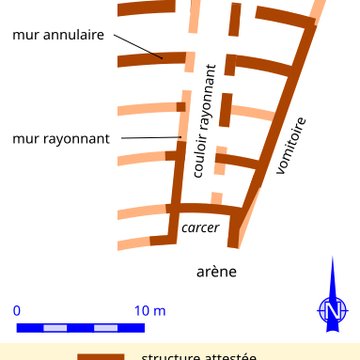
The Gallo-Roman amphitheatre of Agen, built in the 1st century AD, is an ancient monument of 115 × 100 m located in the Tanneries district, showing the importance of Aginnum in Aquitaine second.
Tour de La Tourasse à Aiguillon
Fanum
47190 Aiguillon

La Tourasse is a first-century Gallo-Roman tower, a 5-metre-high cylindrical building located in Aiguillon, New Aquitaine, classified as a historical monument since 1840.
Ancient site of Eysses (Excisum) in Villeneuve-sur-Lot
Fanum
47300 Villeneuve-sur-Lot

The ancient site of Eysses (Excisum) is a Gallo-Roman city of the Upper Empire located in Villeneuve-sur-Lot (Nouvelle-Aquitaine), marked by a forum, a temple dedicated to Mars and an iconic circular tower still visible today.
Roman Ruins of Nerac
Roman ruins
47600 Nérac

The Roman ruins of Nerac are the remains of a Gallo-Roman villa of the 4th and 5th centuries, located in the park of the Garenne, in Nerac, New Aquitaine, with remarkable mosaics and thermal baths.
Amphitheatre of Agen
Gallo-Roman amphitheatre
47000 Agen

The Agen Amphitheatre, a Gallo-Roman building of the first century, is located in the Tanneries district of Agen (Lot-et-Garonne). Its remains, discovered in 1988, could accommodate up to 15,000 spectators.