
Logo Musée du Patrimoine

All French heritage classified by regions, departments and cities

Covered drive from Barbehère to Saint-Germain-d'Esteuil en Gironde

Patrimoine classé
Tumulus
Allées couvertes
Gironde

Covered drive from Barbehère to Saint-Germain-d'Esteuil

    Route de Barbehere
    33340 Saint-Germain-d'Esteuil

Timeline

Néolithique
Âge du Bronze
Âge du Fer
Antiquité
Haut Moyen Âge
Moyen Âge central
Bas Moyen Âge
Renaissance
Temps modernes
Révolution/Empire
XIXe siècle
Époque contemporaine
4100 av. J.-C.
4000 av. J.-C.
0
1800
1900
2000
Néolithique moyen
Construction of the monument
1875
First map entry
1904
Searches by Dr. Jeanty
1987–1991
Programmed search
28 novembre 1989
Registration for Historic Monuments
Aujourd'hui
Aujourd'hui

Key figures

Docteur Jeanty - Owner and searcher (1904) Directed the first official excavations of the site.
J. B. Gassies - Director of the Prehistoric Museum of Bordeaux Mentionna dolmen in 1875 under the name *Bois Charnier*.
François Daleau - Local historian (1876) Specified the location near Potensac (Ordonnac).
Abbé J. Labrie - Author of the report of the excavations (1907) Documented Dr. Jeanty's discoveries.
L. Manouvrier - Anthropologist Studyed 19 individuals out of 80 estimated burials.
Marc Devignes - Archaeologist Analysed architecture as *aquitaine driveway* (1980-1990s).

Origin and history

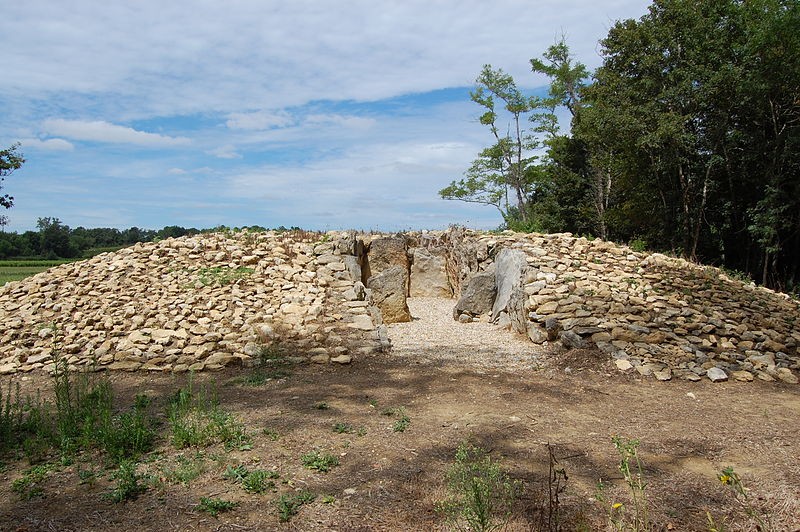
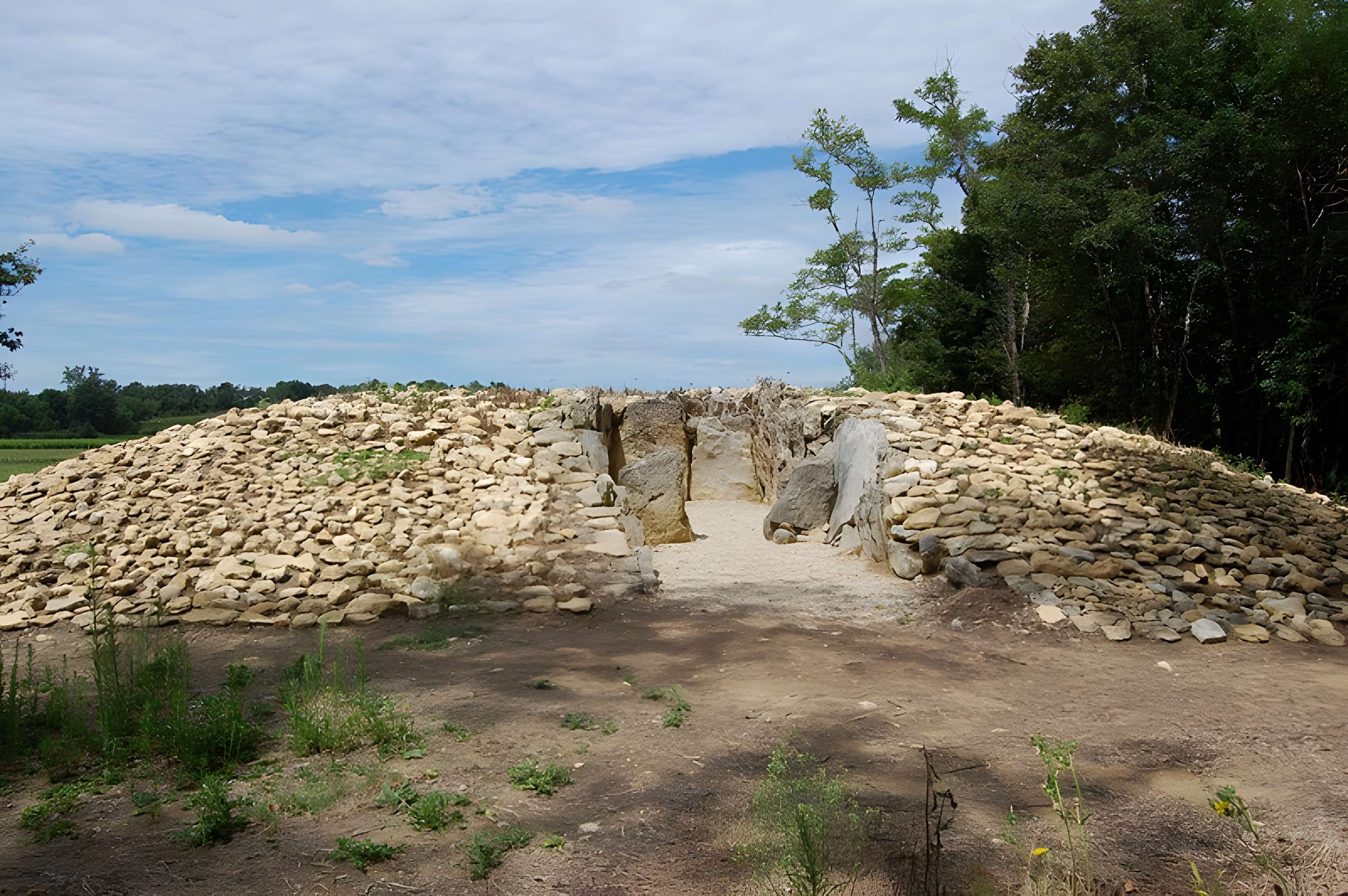
The covered alley of Barbehère, located at Saint-Germain-d'Esteuil en Gironde (Nouvelle-Aquitaine), is a megalithic monument erected in the Middle Neolithic, but reused up to the Chalcolithic by various cultures (Matignons, Artenaciens, Peu-Richardiens, Campaniformes). Its architecture, characteristic of the aisles of Aquitaine, is distinguished by an oblong tumulus of 20 m long, a funeral chamber divided by two symmetrical slabs, and a narrow vestibule. The excavations revealed bones of nearly 80 individuals, flint tools, limestone beads, and pottery coats dating back to several periods, attesting to prolonged occupation.

The site was mentioned in 1875 on a map of the Gironde as a tumulus, then identified as a violated dolmen, where human skeletons were discovered. A controversy at the beginning of the twentieth century opposed historians about the existence of one or two nearby dolmens (Barbehera and Bois Charnier), before excavations confirmed the uniqueness of the monument. In 1904 Dr. Jeanty undertook the first official excavations, exhuming bones and artifacts (points of arrows, pearls, campaniform pottery), although most remains have since been lost.

A rescue search in 1987 followed by a programmed campaign (1988–1991) allowed us to study more than 2000 teeth and 50,000 bone fragments, as well as abundant furniture: neolithic and protohistoric ceramics, flint tools (armatures, scrapers), and trimming elements (calcareous pearls, dentals, Chalcolithic gold torturers). These findings confirmed the multicultural reuse of the site, although the absence of charcoal prevented carbon dating 14. The monument was inscribed in the Historical Monuments in 1989.

The architecture of Barbehère is singularized by its trapezoidal burial chamber preceded by a vestibule, and by the absence of traces of roof tables (destroyed or replaced by wooden beams). The orthostats of the bedside, regularized by snooping, may have been decorated with red ocre, a practice rare in Aquitaine but attested in the Iberian peninsula. All the slabs, made of local limestone extracted 500 m from the site, highlight the adaptation of the builders to environmental resources.

The monument illustrates the collective funeral practices of Neolithic, with successive burials and furniture reflecting cultural exchanges (silex, gold, campaniform pottery). His fortuitous discovery of a polished stone axe at the beginning of the twentieth century, as well as subsequent excavations, revealed a major site to understand the transitions between Neolithic and Age of Metals in Aquitaine. Today, he remains the only dolmen in the state of the Medoc, preserving the unique remains of that time.

External links