Historical Monument 2000 (≈ 2000)
Official protection of the castle.
Aujourd'hui
Aujourd'hui
Aujourd'hui Aujourd'hui (≈ 2025)
Position de référence.
Heritage classified
Castle (cad. DL 95 ) : inscription by order of 30 June 2000
Key figures
Arnaud de Montratier - Former owner (Lord of Favols)
Sell the castle in 1464.
Jean et Jacques d’Hébrard - Acquirers in 1464
Brothers become owners.
Jean de La Fabrie - Owner from 1597
Conservative family until the 18th century.
Origin and history
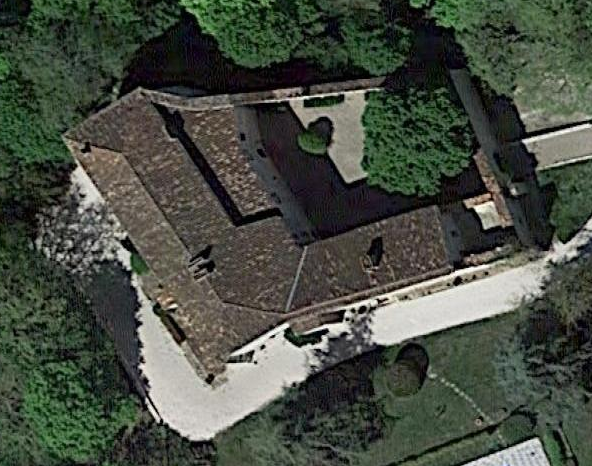
The Château de la Sylvestrie, located in Villeneuve-sur-Lot (Lot-et-Garonne), is a medieval building dating back to the early thirteenth century. It was initially composed of two houses arranged in return of square, backed by a defensive enclosure. The latter, with its archères, as well as the southern wing made of stone, date from the late 13th or early 14th century. A groined bay, located upstairs, probably illuminated the main hall, suggesting that the building was originally higher. Two ancient capitals, re-used in the vaults of the cellar door, testify to the recovery of older materials.
In the 15th century, a spiral staircase was added, marking a first phase of transformation. The castle underwent further modifications at the turn of the 15th and 16th centuries, including the opening of crosses and the addition of a lined west wing. The western cross, decorated with pilasters and canned columns, dates from the second half of the 16th century. These accommodations reflect an adaptation to the architectural tastes of the Renaissance, while preserving medieval elements such as old floors and ceilings, including a decoration painted on beams on the first floor.
Historically, the estate changed hands several times. In 1464, Arnaud de Montratier, Sieur de Favols, sold it to the brothers Jean and Jacques d'Hébrard. In 1597, the castle was acquired by Jean de La Fabrie, whose family kept it until the end of the 18th century. At its peak, in 1812, the castle consists of three wings in U. Ranked Historic Monument in 2000, it still dominates the Cambes valley and the church of Collongues, offering an architectural testimony of the evolutions between the Middle Ages and the modern era.






Announcements
Please log in to post a review