Construction of the cross XVIe siècle (≈ 1650)
Construction period attested by Monumentum.
27 juin 1984
Registration for Historic Monuments
Registration for Historic Monuments 27 juin 1984 (≈ 1984)
Official protection by ministerial decree.
Aujourd'hui
Aujourd'hui
Aujourd'hui Aujourd'hui (≈ 2025)
Position de référence.
Heritage classified
Crossroads (Case D 759): inscription by order of 27 June 1984
Origin and history
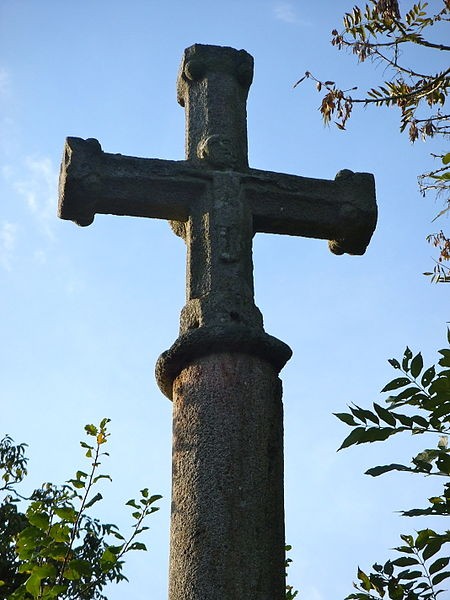
The cross of crossroads of Lezoux is a historic monument erected in the 16th century, located on the town of Lezoux, in Puy-de-Dôme. This monument consists of a slab of sandstone forming its base, surmounted by a lava andesite base. This base, of cubic shape at its base, is transformed into a pyramid trunk supporting an octagonal part framed by two toers. The drum, first cubic and then octagonal, is extended by a cylindrical cross section connected to the cross by a truncated knot. The arms of the cross, octagonal, end with cubic swellings decorated with balls at the corners.
On one side of the cross, a crucified Christ is carved in low relief, dressed in a tunic. The opposite side presents a circular nimble containing a quadrilobe, typical symbol of medieval and reborn Christian iconography. This monument, inscribed in the inventory of Historical Monuments by order of 27 June 1984, belongs to the municipality of Lezoux. Its location, at the intersection of CD 229 and Orcher Road, reflects its original role as a spiritual and geographical landmark for travellers and the local population.
The location of the cross, noted as "passable" (note 5/10) in the databases, suggests an approximation in the available coordinates. The materials used, sandstone and lava andesite, are characteristic of the local resources of the volcanic region of Auvergne. This type of cross, common in the French countryside from the Middle Ages, served as both a territorial marker, a place of devotion and symbolic protection against dangers to passers-by.
The inscription of the cross as a historical monument in 1984 underlines its heritage value, both for its architecture and its iconography. The communal property guarantees its preservation, although its current access or vocation (visit, worship, etc.) is not specified in the available sources. Photographs such as Rilba's Creative Commons license document its current state and contribute to its cultural enhancement.






Announcements
Please log in to post a review